Learning Structured Sparsity for Large Models: Bridging Model Compressibility and Efficient Inference
Rank ratio target: 15%. Sparsity target: 95%. In the example, S-SALAAD is 1.73 times faster and reduces peak VRAM from 3,713 MB to 1,961 MB compared with dense inference.
Abstract
Large models increasingly need to run on the device itself. Unreliable connectivity, communication delays and privacy requirements make the cloud a poor fit for many applications, so models must fit into limited memory and still run fast on local hardware.
Fewer parameters do not automatically mean faster inference. Learning sparse-plus-low-rank weights lets a single checkpoint be compressed to any memory budget. But when the sparse part is unstructured, indexing overhead and irregular memory access can erase the expected speedup.
S-SALAAD learns sparsity that hardware can actually use. During training, every weight matrix is learned as a low-rank part plus a structured sparse part, such as blocks, rows, columns or patterns. Budget-aware compression and dedicated CPU and GPU kernels then turn that structure into real savings, from one checkpoint across all memory budgets.
The result: elastic, smaller and faster models. On Llama2 and Qwen3, in both pretraining and distillation, S-SALAAD advances the Pareto frontier in perplexity, memory and latency on multiple hardware platforms.
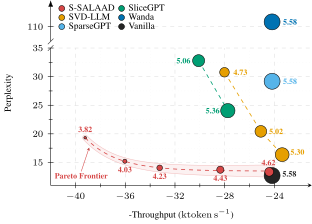
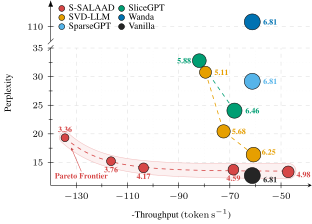
Qwen3-1.7B elastic compression
S-SALAAD runs up to 1.62× faster on GPU and 2.20× faster on CPU than dense inference. Perplexity versus prefill throughput. Marker size represents peak memory; labels report GB1.
Citation
@misc{xia2026structured, title = {Learning Structured Sparsity for Large Models: Bridging Model Compressibility and Efficient Inference}, author = {Xia, Tianxiang and Lion, Kai and He, Niao and Muehlebach, Michael and Zeilinger, Melanie and Ma, Hao}, year = {2026}, note = {Preprint}}